



Collateral Over Confidence: Why Secured Short-Term Investing Is Gaining Relevance for Corporate Treasurers
Reference
In an environment shaped by tighter liquidity management, higher funding costs, and closer scrutiny of counterparty risk, corporate treasurers are reassessing long-standing approaches to short-term cash investment.

While bank deposits and money market funds (MMFs) remain core components of the treasury toolkit, secured instruments such as triparty repo are gaining renewed attention. The question has shifted from whether repo has a role to play, to how it can support a more balanced, resilient, and forward-looking cash investment strategy.
Moving beyond unsecured cash investments
Simplicity has long been a defining feature of corporate treasury. Bank deposits, term deposits, MMFs, and short-dated securities remain familiar, well-governed, and operationally efficient instruments, making them natural starting points for managing liquidity.
Yet simplicity often comes with risks of its own.
Deposits create concentrated, unsecured exposure to individual financial institutions. MMFs provide diversification at first glance, but their underlying portfolios often include many of the same banking names that corporate treasurers are already exposed to. In this sense, diversification across investment vehicles does not always translate into diversification of underlying credit exposure.
In addition, MMFs carry inherent liquidity risk: the risk that a fund could temporarily suspend an investor’s ability to withdraw money (a "gate"). This can occur during periods of extreme market stress, when too many investors request redemptions at once, forcing the fund to freeze withdrawals.
Against this backdrop, the treasury mandate is evolving. Boards and treasury committees are placing greater emphasis on counterparty concentration, resilience under stressed market conditions, and the efficient deployment of corporate liquidity. Prudent treasury management is no longer focused solely on capital preservation, but increasingly on adopting more diversified and structurally robust allocation approaches.
Why repo is entering the treasury world
Repo approaches the same investment challenge from a fundamentally different angle.
Rather than placing unsecured deposits, the corporate lends cash against eligible securities posted as collateral. These transactions are structured so that cash and collateral are exchanged simultaneously, with collateral revalued and margins adjusted as market prices evolve. The collateral is held in a segregated account and can be accessed in the event of counterparty default.
This structure fundamentally changes the nature of the exposure. Counterparty risk is not removed, but it is mitigated through collateral, creating a more robust risk profile than unsecured alternatives.
This distinction becomes particularly relevant during periods of market uncertainty. While no investment structure eliminates risk entirely, collateralization introduces an additional layer of protection that unsecured investments cannot provide. At the same time, treasurers retain flexibility in defining the type and quality of collateral they accept, allowing them to align investment decisions with their own risk frameworks.
The growing relevance of repo is also being shaped by broader market dynamics. Financial institutions are operating within stricter regulatory frameworks, including the Net Stable Funding Ratio (NSFR), which incentivizes access to stable funding sources. Funding from non-financial corporates is often treated more favorably than funding from financial counterparties, increasing demand for corporate liquidity.
At the same time, central banks are gradually reducing excess liquidity, while regulatory reforms continue to reshape bank balance sheets. Together, these factors are strengthening demand for secured funding.
For corporate treasurers, this creates a more supportive environment. Providing liquidity on a secured basis can improve the overall risk profile of investments while also offering competitive returns, reflecting the structural demand from market participants.
This dynamic is likely to become even more relevant as T+1 settlement shortens funding cycles and increases demand for reliable short-term liquidity across capital markets.
Why adoption of repo has remained limited
Given these advantages, it is reasonable to ask why repo has not played a larger role in corporate treasury to date.
The answer lies less in economics than in accessibility.
For many treasury teams, repo has traditionally been viewed as part of the institutional domain of dealers, investment banks, and securities financing specialists. Legal documentation, custody arrangements, collateral eligibility, settlement processes, and daily valuation can appear significantly more complex than placing funds on deposit or investing in a money market fund.
There has also been a practical gap between corporate treasury and institutional funding markets. Traditional banking coverage models often separate corporate cash management from securities financing expertise, leaving many treasurers aware of repo but without a straightforward way to access it.
As a result, adoption has often been held back by perceived complexity rather than by a lack of strategic relevance.
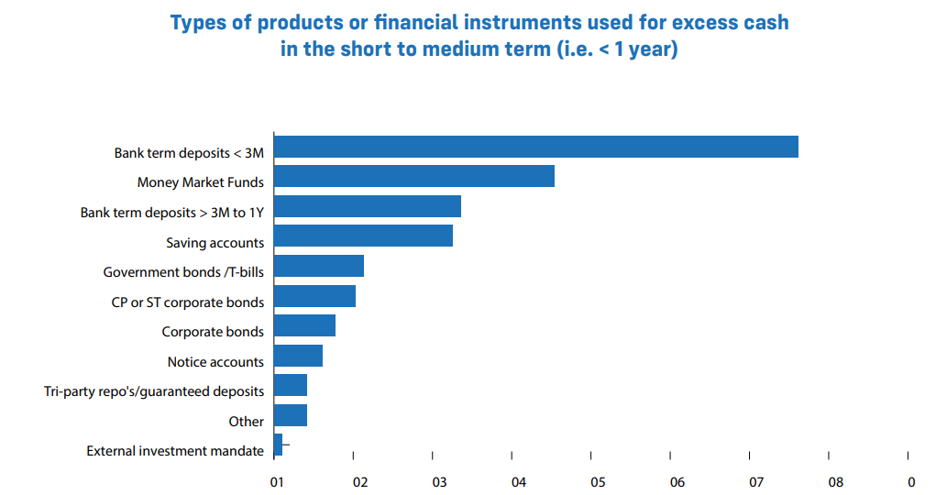
Source: EACT Treasury Survey 2025
How triparty structures automate processes and reduce complexity
Triparty repo has fundamentally changed that equation.
The innovation lies not in the repo transaction itself, but in the operating model that supports it.
Under a triparty model, the commercial relationship remains between the corporate and its counterparty. However, the operational responsibilities (collateral selection, optimization, valuation, substitutions, corporate actions, and settlement) are delegated to a neutral triparty agent, such as Clearstream. The triparty agent ensures the simultaneous exchange of securities and cash on a delivery-versus-payment (DvP) basis, preserving settlement integrity while minimizing operational risk.
This model simplifies access to secured investing. By transferring operational complexity to a specialized infrastructure provider, treasury teams can benefit from collateralized transactions without building internal capabilities in collateral management.
Equally important is the growing standardization of legal documentation. Historically, establishing repo relationships often required lengthy bilateral negotiations with each counterparty. Standardized frameworks, such as the Clearstream Repurchase Conditions (CRC), allow multiple counterparties to transact under a common legal agreement, materially reducing onboarding effort and cost while making it easier to diversify counterparty relationships over time.
Technology is playing an equally important role. Integration with established treasury and trading platforms is steadily lowering operational barriers, enabling corporates to access secured funding markets without building extensive in-house infrastructure.
Preserving relationships while enhancing resilience
An important feature of triparty repo is that it can be integrated into existing treasury structures without disruption.
Corporates can continue to work with their current banking partners while shifting part of their exposure into a secured framework. This allows them to strengthen risk management without fundamentally changing their counterparty relationships. At the same time, standardized models can facilitate access to a wider group of counterparties, supporting further diversification and reducing concentration risk.
For organizations seeking an additional layer of protection, centrally cleared solutions, such as Eurex GC Pooling, further reduce bilateral counterparty exposure by introducing a central counterparty, while retaining the operational efficiencies of triparty collateral management.
Toward a more balanced cash investment strategy
Repo should not be viewed as a replacement for deposits or money market funds. Each continues to play an important role within a diversified treasury investment policy.
Rather, secured lending expands the range of available tools available, allowing excess liquidity to be allocated across differing objectives for security, liquidity, diversification, and return.
The broader trend is clear: treasury management is moving beyond passive cash placement toward a more deliberate and strategic discipline. In a market characterized by tighter liquidity, changing regulation, and increasing balance sheet scrutiny, the ability to combine collateral protection with operational simplicity has become particularly valuable.
For corporate treasurers reviewing their investment frameworks, the key question is evolving. about it is no longer whether repo is too complex, but whether existing liquidity strategies fully reflect the range of secured investment opportunities now available.


