



T2S and CEU Releases: Information on the production launches in November 2026 - Update IV
Reference

T2S RELEASE SUPPORT
Note: This Announcement, originally published on 22 May 2026, updated on 20 July 2026, 12 August 2026, and 21 September 2026, has been further updated to confirm the implementation of the new software in the T2S client simulation environment UTEST and to deliver more details about the CEU release. Changes have been highlighted.
Clearstream Europe AG1 informs clients about the upcoming TARGET2-Securities release in November 2026 (T2S R2026.NOV). According to the notification published by the European Central Bank (ECB) and as agreed with the involved CSDs and central banks, the implementation of the entire scope will be postponed to
the weekend 28 and 29 November 2026
for business day, Monday, 30 November 2026
Background
On 4 September 2026, the decision was made by the Eurosystem that the scope elements implementation of T2S Release R2026.NOV will be introduced on 30 November 2026. The following information was provided by the ECB for circulation to the T2S Actors:
Confirmation of two-week postponement for T2S release R2026.NOV
4 September 2026
The Eurosystem has decided to proceed with the planned November 2026 releases for its TARGET Services, shifting their deployment from 14 November 2026 to 28 November 2026. The decision follows the recent announcement by SWIFT to delay its Standards Release 2026 following the industry’s request for additional time to prepare for the removal of unstructured postal address.
The Eurosystem has assessed the impact of the SWIFT decision on its market infrastructures and on key stakeholders, in close collaboration with European market participants. To proceed with the planned scope of the releases for T2, T2S, TIPS and the Eurosystem Collateral Management System (ECMS), changes will need to be implemented by all stakeholders, necessitating a two-week delay.
The postponement affects all scope items allocated to the T2S Release R2026.NOV and thus all CEU clients are impacted regardless of their acting in ICP and/or DCP mode.
T2S Release R2026.NOV – Scope
With the T2S Release in November 2026, nine Change Requests (CRs) will be introduced in production. They have already been approved at T2S Steering Level. In the event of urgency and if priority is given, further functional updates might be authorised by the Operational Managers Group (OMG). If such changes are announced by T2S, CEU will inform clients in due time.
With this Announcement, CEU informs clients about the scope elements for T2S Release R2026.NOV and indicates if the modification might impact CEU clients acting in ICP and/or DCP mode:
- Overview T2S Change Requests
The report attached shows nine approved T2S Change Requests (CRs). More details on these requirements can be found in the related ECB documentation2.
- Problem Tickets (PBIs)
CEU regularly reviews the lists of pending PBIs provided by T2S. The analysis of the list published mid of August 2026 currently shows four T2S Problem Tickets (PBIs) that might impact CEU’s clients operating in DCP mode. One further PBI affecting DCPs is still waiting for the final decision to be implemented with the T2S R2026.NOV release (candidate). CEU recommends clients to check the PBI list attached.
Experience from CEU’s periodic assessment of these lists shows that until the launch of a T2S release, additional tickets will be authorised for implementation. Therefore, this Announcement will be updated with newly prioritised PBIs. - Transition plan
The installation of the T2S Release into production is planned for the last weekend in November 2026. The deployment will be executed via the “Release Weekend Schedule”. In line with the deployment approach of previous T2S Releases, the schedule of the T2S Operational Day will be modified due to the implementation activities. The deployment will start once the end of day procedure (“T2S End of Day”) on Friday, 27 November 2026, has been completed. Beginning of November 2026, CEU aims to provide an indicative timeline for changes in the operational day during the deployment weekend.
The table below provides an overview of the important T2S milestones within the next months:
T2S Release in November 2026 - Service Transition Plan | |
Activity for T2S Release in November 2026 | Date |
End of testing of R2026.NOV scope elements in Pre-Production | Wednesday, 11 November 2026 |
Market Infrastructure Board (MIB) approves the R2026.NOV deployment to Production | Tuesday, 17 November 2026 |
Deployment of R2026.NOV to Production | Saturday, 28 November 2026 |
T2S CRs with potential client impact
The following CRs complement the current scope of services and will be available to CEU clients after the implementation of T2S Release R2026.NOV. CEU recommends clients to review the changes for any necessary adjustments in their operational procedures.
T2S-0828-URD “T2S should no longer release cash restrictions related to CoSD blocking at real-time closure”
Currently, during Real-Time Settlement Closure phase, T2S releases all CoSD cash blockings and attempts to re-generate them on the next Business Day only. Between the RTS Closure and the regeneration of the CoSD blocking, external settlement cannot be reflected in T2S. With this CR, T2S will deactivate the process to release all cash settlement restrictions for CoSD blocked cash during Real-Time Closure phase and instead keep such CoSD blocked cash on the Dedicated Cash Account (DCA) during T2S End of Day (EoD). Like this, it is continuously ensured that this cash can be used to conclude the settlement on T2S after the external settlement was confirmed.
CEU clients will benefit from this new process for the external settlement against EUR in CEU assets migrated by Unified for New Opportunities (UNO).
T2S-0843-SYS „Support UTI in T2S messages according to ISO 20022 CR 1408 ‘Change of UTI implementation’”
The Unified Transaction Identifier (UTI) provides a globally unique reference of 52 characters interlinking all related messages in the same end-to-end settlement transaction, which every party in the chain can use to refer to the transaction. It is used to report settlement transactions to a trade repository as required by the European Market Infrastructure Regulation (EMIR) or EU’s Securities Financing Transactions Regulation (SFTR).
This T2S Change Request will make the UTI reference available in T2S customized messages.
CEU clients will be able to enter and see the UTI reference in Xact Web Portal. The ClearstreamXact reporting will reflect the UTI reference as follows:
16R:LINK
:20U::TRRF//549300OL514RA0SXJJ442LS94203705455771120260720081143 [Example for a UTI]
:16S:LINK
T2S-0798-URD “T2S CoSD logic should support partial release of instructions”
Attention: CEU implementation suspended until further notice3
Conditional Settlement (CoSD) is a process which allows settlement in T2S with the requirement to fulfil a condition outside T2S before achieving the final booking. The CoSD rules are set by each central depository (T2S In-CSD) to identify if a conditional settlement applies on a Settlement Instruction.
CEU uses the T2S Conditional Settlement, for example, for instructions that settle:
- In markets outside T2S (T2S Out-CSDs for NCSC-T securities); or
- Against currencies other than EUR (cash settles with Clearstream Banking S.A. (CBL)).
The current T2S CoSD process is incompatible with the T2S partial settlement and partial release.
This CR aims to enable partial party blocking and release for instructions subject to CoSD. If, for instance, a T2S Out-CSD allows partial settlement, then this partial settlement will be reflected in T2S as well, once the responsible T2S In-CSD confirms this partial settlement to T2S.
Once satisfactory testing results will be achieved, CEU clients will benefit from more settlement efficiency in the following scenarios and conditions:
Partial releases for delivery legs and partial settlement for receipt legs of transactions against a counterparty with:
- CBL (in EUR and non-EUR); and
- Euroclear Bank (EB, Bridge settlement) in EUR and non-EUR.
Partial release for delivery instructions and partial processing for receipt instructions will not be possible for Clearstream Europe internal instructions (CEU-CEU) in non-EUR. A corresponding expansion of this service will be introduced in a later release.
For CEU assets held via CBL (securities migrated by UNO plus Eurobonds (XS-ISINs) eligible for settlement in T2S/CEU), the following will apply:
ClearstreamXact MT548 Reporting of partial settlement for receipt legs of transactions against CBL or EB in EUR and non-EUR (and further UNO markets to be admitted to T2S partial settlement)
In line with the approach described in the Unified for New Opportunities Detailed Functional Specifications Wave One in section 3.3.2, the partials reporting for pending transactions (MT548) will show as Data Source Scheme (DSS) CEDE plus the following reason codes:
Full settlement without partial settlement:
:25D::SETT/CEDE/CDLR
:24B::PEND//CDLR
:70D::REAS// CBL (or EB) Settlement Confirmed. COSD Release Pending
Partial settlement (not last)
:25D::SETT/CEDE/CDLR
:24B::PEND/CEDE/PAIN
:70D::REAS// CBL (or EB) Partial Settlement Confirmed. Partial COSD Release Pending
Last partial settlement
:25D::SETT/CEDE/CDLR
:24B::PEND/CEDE/PARC
:70D::REAS// CBL (or EB) Last Partial Settlement Confirmed. Last COSD Release Pending
No change of partial settlement indicator for receipt legs of transactions against CBL or EB in EUR and non-EUR (and further UNO markets to be admitted to T2S partial settlement)
If CEU clients instruct the receipt leg of a transaction against CBL or EB in EUR and non-EUR with PARC (partial settlement allowed beyond a defined cash threshold) or PART (partial settlement allowed) or without any explicit partial settlement indicator, then T2S applies a cash amount threshold whereas CBL and EB do not apply it. Hence, a partial delivery from a CBL or EB under the T2S cash threshold cannot be settled.
For receipt legs of transactions in CEU assets held via CBL, a change of the partial settlement indicator is not possible, nor in Xact Web Portal, nor by MT530. Hence, CEU strongly recommends instructing these receipt instructions since the beginning with the partial settlement indicator PARQ (partial settlement allowed beyond a defined stock threshold). Like this, no partial deliveries under the T2S cash threshold are generated by CBL or EB, which will never settle in T2S.
CEU Release
Following the successful standardisation of processes, services and reporting for Asset Servicing, CEU aims to achieve a similar level in Settlement Services.
The target is to align the service offering with T2S and Swift standards as well as a harmonisation between CEU and CBL.
The client ClearstreamXact Reporting has therefore been and continues to be enhanced during 2025 and 2026.
With the November 2026 release, which has been postponed to 28 November 2026 along with the T2S release, the following improvements will be implemented:
Optional Sequence C in MT530 message
CEU clients will be able to submit MT530 message (Transaction Processing Command) to perform modifications without the obligation to consider the fields in Sequence C - Additional Information.
Rejections due to this sequence being mandatory will no longer apply.
MITI Referencing in modification and cancellation requests
CEU clients will be able to send the Market Infrastructure Transaction Identifier (MITI) Reference to CEU in order to submit:
- Modification of instructions via MT530 with the MITI information provided in the field :20C::MITI
- Cancellation of instructions via MT540-543 with qualifier CANC and the MITI provided in the field :20C::RELA.
This information will be visible in Xact Web Portal as well as in the ClearstreamXact settlement reporting and will be valid for Swift messages MT537, MT548, and MT544-547.
MITI Referencing in MT900/910/950/camt.054
In order to identify the settlement and cash legs of a Conditional Securities Delivery (CoSD), the MITI Reference (Market Infrastructure Transaction Identifier) will replace the currently used CASCADE reference called Auftragsnummer in the following reports:
- MT900;
- MT910;
- MT950;
- camt.054.
To avoid potential truncation in MT950, the term "BOOK TRANSFER" will be replaced by "BT" to allow the reporting of the MITI reference with 16 characters. This applies only for MT950 related to Intra-CSD (CEU-CEU) instructions on foreign currencies.
The below example illustrates the change in an MT950 Swift message:
Current state:
:61:2605070507D4556,07FMSCC654171821BCC9A1//C654171821BCC9A1
BOOK TRANSFER (6XXXX)/RELA/XXXXXXX [CASCADE Auftragsnummer]:
Future state:
:61:2605070507D4556,07FMSCC654171821BCC9A1//C654171821BCC9A1
BT (6XXXX)/RELA/XXXXXXXXXXXXXXXX [MITI reference]
CASCADE-RS: Internal Registered Shares (RS) Account Transfers (AA01P) in ClearstreamXact reporting
CEU reports Internal RS Account Transfers (ISO transaction code OWNE, instruction type AA01P, identical deliver and receipt account, not settled in T2S) in Xact Web Portal, in CASCADE Online, in the ClearstreamXact (ISO 15022 and 20022) and in LIMA (ISO 15022) reporting.
With the release in November 2026, to avoid double reporting, the ClearstreamXact display and reporting for Internal RS Account Transfers will be decommissioned. The Internal RS Account Transfers continue to be reported in LIMA Settlement Reporting (MT54X) in one booking to be identified in the following fields:
- :22F::SETR//OWNE in Sequence E “Settlement Details”; and
- :13B::LINK/DAKV/DAKVDEFFXXX in the Subsequence A1 „Linkages“.
Realignments for CEU assets held via CBL
CEU assets held via CBL are all securities migrated by UNO plus Eurobonds (XS-ISINs) eligible for for settlement in T2S/CEU. ISINs can be checked to be CEU assets held via CBL in the Codelist or in Xact Web Portal.
Codelist:
Under the header "Other Information", the characteristic "CEU assets held via CBL" shows a "Yes":

Xact Web Portal:
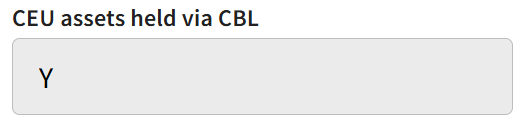
Under the header Flags & Eligibility, the characteristic "CEU assets held via CBL" shows a "Y":
CBL-CEU realignments: New format
With the CEU release in November 2026, the CBL instruction format for realignments of positions from a five-digit CBL account (among others 6-series accounts) to a seven-digit CEU account
- in CEU assets held via CBL; and
- without the UCSA-Identifier
(Further details on the UCSA-Identifier Service are available in the Unified for New Opportunities Detailed Functional Specifications Wave One, specifically in section 3.3.1.)
is aligned in the fields 95R::BUYR and 95R::SELL to the T2S Securities Account (SAC) format.
Current CBL format of the BUYR and SELL fields in realignment instructions for NCSC-T securities:
- :95R::BUYR/DAKV/XXXX
- :95R::SELL/DAKV/XXXX
Future CBL format of the BUYR and SELL fields in realignment instructions for CEU assets held via CBL:
- :95R::BUYR/DAKV/DAKVXXXXxxx
- :95R::SELL/DAKV/DAKVXXXXxxx
Generally, CEU recommends switching to the :95P:: field in combination with a :97A::SAFE option instead of using 95R:
- :95P::SELL//SELLDEFFXXX or :95P::BUYR//BUYRDEFFXXX
- :97A::SAFE//44440000
CBL/EB to CEU realignments: settlement only with active matching
With the CEU release in November 2026, CEU passive matching will not be available anymore for deliveries of CEU assets held via CBL (securities migrated by UNO plus Eurobonds (XS-ISINs) eligible for settlement in T2S/CEU) from a five-digit CBL account, a 6-series account or a Euroclear Banking (EB) account to a 7-digit CEU account. All CEU clients must enter matching receipt instructions, especially for realignments between 6-series accounts and CEU accounts, even if their receiving CEU account is set up as a passive matcher in the CEU static data.
If a deliverer would like to ensure if the security to be realigned to a CEU passive matcher needs a receipt instruction (and hence the receiving CEU party needs to be informed about the delivery), the ISIN can be checked to be a CEU asset held via CBL in the Codelist or in Xact Web Portal (see description above).
CBL/EB to CEU realignments: Change in Allegement service
With the CEU release in November 2026, CEU clients will no longer receive allegements for transactions:
- in CEU assets held via CBL; and
- between a CEU account and a CBL account, including 6-series accounts, or EB accounts.
The Allegement Service for all instructions other than CBL/EB to CEU realignments in CEU assets held via CBL remains unchanged.
CBL/EB to CEU realignments: Common Reference in ISO 20022 messages
With the CEU release in November 2026, in CBL/EB to CEU realignments, the common reference in the Swift ISO 20022 field Common trade reference (<Cmonld>) will no longer be mandatory, but optional as in the Swift ISO 15022 format (field :20C::COMM/).
__________________________________________________________
O Common trade reference – <Cmonld> Common trade reference
__________________________________________________________
CASCADE-RS
Portfolio transfers with dumps
In the event of a portfolio transfer without a change of the beneficial owner (for example, when the beneficial owner changes its custodian bank), CEU transfers the registered shares of the beneficial owner to the account of the new custodian bank and informs the registrars of the new custodian bank (without changing the details of the beneficial owner).
However, this process runs contrary to the demand of "active matchers," who do not want to receive unsolicited positions in their accounts without corresponding receipt instructions from their side.
To avoid unsolicited securities credits in the accounts of active matchers, CEU is introducing a new field "AA01/P Exclusion" in the client master data of each CEU main or sub-account. Through this field, active matching clients can exclude unsolicited securities credits resulting from portfolio transfers of CASCADE-RS registered shares (by setting the field value to "J" ("Ja"; “Yes”).
If, in the future, a portfolio transfer is submitted against an account with the value “J” in the“AA01/P Exclusion” the delivery will be rejected with error code “Registered shares, active matching required”. Consequently the transferring custodian bank must have the beneficial owner deregistered from the registers and transfer the unregistered positions to the new custodian bank via a standard securities transfer (“Wertpapierübertrag”; free of payment and requiring matching). The receiving bank must match the delivery with a corresponding receipt instruction and ensure that the positions are reregistered in the name of the beneficial owner. Clients should refer to the “CASCADE-RS Praxisführer Teil 1” (available only in German) for the process (pages 46f).
By default, all values in this new master data field are blank (meaning portfolio transfers with unsolicited securities credits are allowed). Active matching clients can request to set the new value to "J" via a free-format text message in ClearstreamXact or via a Swift MT599 message under the reference "CASCADE-RS matching" addressed to CEU OSM Client Data Management for the to be explicitly listed CEU main or sub-accounts.
Further information can be found in Registered Shares Announcement RS26027.
Client simulation
Regression testing in the CEU testing environments IMS23 (CASCADE) and OCCT (ClearstreamXact) is possible. The already established static data for CEU accounts and the related connectivity settings in the CEU client simulation environments remain unchanged. If clients need any adjustments of the setup in the client simulation environment or additional information on the simulation requirements, they can contact connect-test@clearstream.com.
According to the ECB planning, the updated software for the T2S Release R2026.NOV has been installed on Friday, 9 October 2026, in the T2S Pre-Production Environment (UTEST). From Monday, 12 October 2026, DCPs can start their simulation activities. In IMS23, the new software will be available on 26 October 2026. Details about extraordinary closing days and opening hours (UTEST/IMS23/OCCT) are available under Availability and schedules of the client simulation.
------------------------------------------
- This Announcement is published by Clearstream Europe AG (CEU), registered office at Mergenthalerallee 61, 65760 Eschborn, Germany, registered with the Commercial Register of the District Court in Frankfurt am Main, Germany, under number HRB 7500.
- Details about the scope elements of T2S Releases are published on the ECB’s website (status of beginning of March 2026).
- During the preparatory testing, deviations from the planned functionality have been found (documented in PBIs 240143 and 240191), which currently prevent a CEU implementation and must previously be fixed and re-tested. CEU will keep clients informed.

